
Key takeaways:
- Same-admission cholecystectomy was linked to lower risk for recurrent pancreatitis and other complications.
- Recurrence risk was similarly low with ERCP, but risk for gallstone-related complications was higher.
Same-admission cholecystectomy was linked to lower risk for disease recurrence and gallstone-related complications in patients with mild gallstone-related acute pancreatitis who are fit for surgery, according to population-based study results.
Findings also showed that patients who underwent endoscopic retrograde cholangiopancreatography had lower risk for recurrent disease over time, but were at greater risk for other gallstone-related complications, including acute cholecystitis and choledocholithiasis.

Data derived from Selin D, et al. JAMA Surg. 2026;doi:10.1001/jamasurg.2026.2168.
Although guidelines recommend same-admission cholecystectomy for mild gallstone-related acute pancreatitis, only 55.6% of affected individuals in the U.S. undergo the procedure, according to study background. Treatment decisions are more complex for older patients or those with significant comorbidities.

Daniel Selin, MD
“While same-admission cholecystectomy is the recommended treatment for most patients, the procedural risks may outweigh the benefits in some individuals,” Daniel Selin, MD, a PhD student in the department of clinical science, intervention and technology at Karolinska Institutet, told Healio.
“We saw a need for better evidence on the long-term outcomes associated with the main treatment strategies — same-admission cholecystectomy, ERCP alone or no intervention during the index admission — to support more individualized risk-benefit assessments in this population.”
Selin and colleagues compared the three strategies among 9,593 individuals (median age, 61 years; 60.3% women) in the national Swedish Pancreatitis database, all of whom were hospitalized for an initial episode of gallstone-related acute pancreatitis between 2006 and 2019.
More than half of patients (54.4%) received no intervention during hospitalization, 28.7% underwent cholecystectomy and 16.9% were treated with ERCP only.
Researchers followed patients from hospital discharge through first recurrence of acute pancreatitis, emigration from Sweden, death or the end of the study period.
Recurrence of acute pancreatitis served as the primary outcome. Secondary outcomes included other gallstone-related complications.
Results showed 11.3% of patients experienced recurrent acute pancreatitis, and 43.4% of these episodes occurred within 1 month.
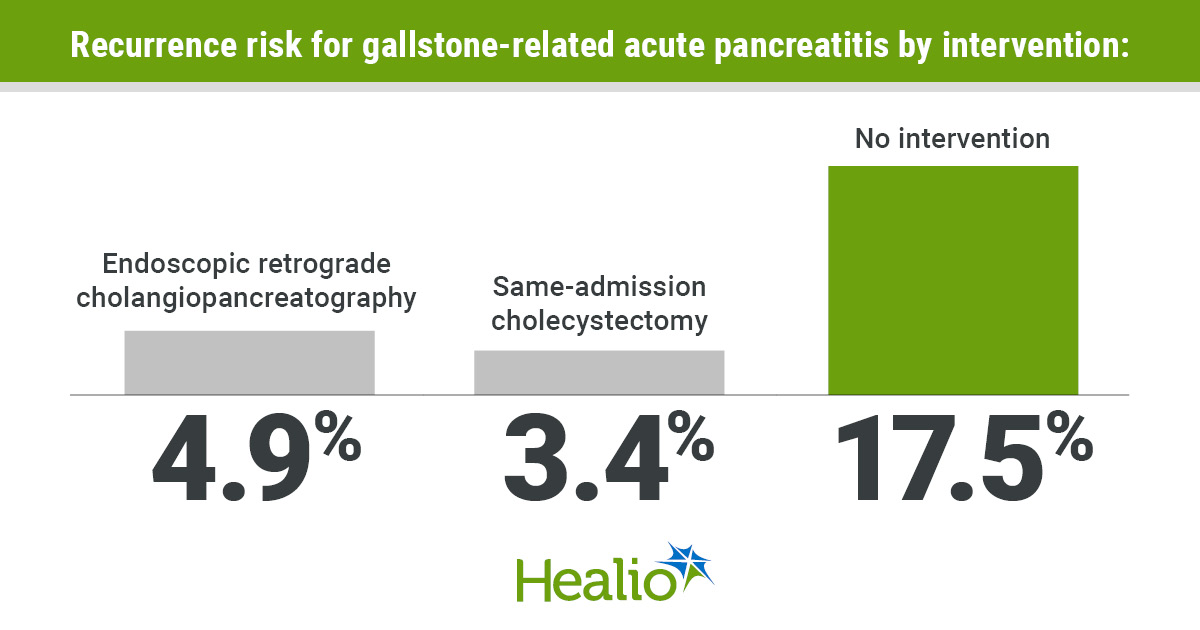
Recurrence was highest among patients who received no intervention (17.5%) compared with those who underwent ERCP (4.9%) or cholecystectomy (3.4%).
“Nearly half of all recurrent pancreatitis episodes occurred within 1 month after discharge, emphasizing the importance of timely treatment,” Selin said.
Multivariable analysis showed risk for recurrence was highest with no intervention compared with cholecystectomy (subdistribution HR [sHR] = 6.06; 95% CI, 4.85-7.56). The risk also was elevated with ERCP (sHR = 1.4; 95% CI, 1.02-1.92), largely due to increased risk in the first 14 days from discharge. After 1 year, ERCP was linked to a reduced risk for recurrence compared with cholecystectomy (sHR = 0.48; 95% CI, 0.24-0.99).
Similarly, those who underwent cholecystectomy had the lowest rate of gallstone-related complications (1.6%) compared with no intervention (16.3%) and ERCP (19.9%).
“Our findings reinforce that same-admission cholecystectomy remains the preferred treatment for patients with mild gallstone-related acute pancreatitis who are fit for surgery,” Selin said.
“At the same time, we found that patients who underwent ERCP alone had low long-term risk of recurrent acute pancreatitis that was comparable to that seen after cholecystectomy,” he continued. “However, they remained at a substantially higher risk of other gallstone-related complications, highlighting that ERCP should not be viewed as a substitute for cholecystectomy in patients who are suitable surgical candidates.”
Researchers acknowledged study limitations, including potential confounding variables such as smoking or alcohol use, difficulty distinguishing between recurrence and discharge flares or other complications, and baseline differences between groups.
Selin noted that while this study and others support same-admission cholecystectomy for patients who are fit for surgery, uncertainty remains for those considered poor surgical candidates due to older age or comorbidities.
“Ideally, a randomized controlled trial comparing ERCP alone with conservative management in patients considered unfit for cholecystectomy would provide the highest level of evidence,” Selin said.
For more information:
Daniel Selin, MD, can be reached at daniel.selin@ki.se.
Perspective

These findings provide important real-world evidence supporting what current clinical guidelines already recommend: Early cholecystectomy during the initial hospitalization for gallstone pancreatitis can help prevent recurrent attacks and reduce the risk for additional biliary complications.
Previous observational studies and randomized clinical trials have demonstrated the benefits of same-admission surgery, and this study reinforces those findings in a large, real-world patient population.
One notable finding is that while ERCP was associated with fewer recurrent pancreatitis episodes compared with no intervention, it did not appear to provide the same protection against other gallstone-related complications. This highlights the ongoing importance of cholecystectomy as the definitive treatment, even when surgery is delayed beyond the initial hospitalization.
As with any observational study, there are limitations to consider. Although the investigators adjusted for many potential confounding factors, there is likely still some degree of selection bias. Patients who did not undergo guideline-recommended early cholecystectomy may have differed in important ways that were not fully captured in the analysis, such as illness severity, other medical condition or factors influencing treatment decisions.
Looking ahead, additional research is needed to better understand why some patients with gallstone pancreatitis do not receive early cholecystectomy in routine clinical practice. Are barriers driven by the severity of a patient’s condition, hospital systems and resources, scheduling challenges or patient preferences? A deeper understanding of these factors could help identify opportunities to improve adherence to evidence-based care and ultimately lead to better outcomes for patients with gallstone pancreatitis.
Disclosures: Wu reports no relevant financial disclosures.

Ask a clinical question and tap into Healio AI’s knowledge base.
- PubMed, enrolling/recruiting trials, guidelines
- Clinical Guidance, Healio CME, FDA news
- Healio’s exclusive daily news coverage of clinical data