September 02, 2026
4 min read

Key takeaways:
- A nationwide cohort study shows that psychiatric disorders occur before and remain after an inflammatory bowel disease diagnosis.
- Parental history does not fully explain the correlation.
Psychiatric disorders present in patients with inflammatory bowel disease both before and after diagnosis, according to a study published in Clinical Gastroenterology and Hepatology.
“Earlier studies have shown an association between IBD and psychiatric disease, but several pressing issues remained,” Jonas F. Ludvigsson, MD, PhD, professor of medical epidemiology and biostatistics at Karolinska Institutet, told Healio. “We wanted to understand when the risk increase for psychiatric disease starts … how long the risk persisted and if it extended beyond the commonly studied anxiety and depression.”

Ludvigsson and colleagues conducted a nationwide cohort study in Sweden from 2007 to 2023 comparing the occurrence of psychiatric disorders from 5 years before to 10 years after a confirmed IBD diagnosis with up to five reference individuals from the general population and IBD-free full siblings.
Data was collected in two periods — prediagnosis, defined as 5 years before diagnosis, and after diagnosis — and assessed separately using hazard ratios.
The prediagnostic analysis included 48,230 patients with IBD and 210,582 reference individuals. Over a median follow-up of 5 years, 8.6% of patients with IBD exhibited a psychiatric disorder compared with 6.8% of reference individuals.
The analysis following diagnosis included 43,862 individuals with IBD (mean age at diagnosis, 41.6 years; 47.3% female), including 11.3% with childhood-onset IBD, and 178,821 reference individuals.
Researchers noted patients with IBD used healthcare services more frequently and displayed higher rates of parental psychiatric history.
During the 7.4-year follow-up, 16.5% of patients with IBD presented with a psychiatric condition compared with 12.8% of their reference counterparts. Psychiatric disease tended to occur more in Crohn’s disease. Major depressive disorder, anxiety disorders and substance misuse were documented in both cohorts.
Notably, the researchers observed that the risk for psychiatric disorders began to rise 2 to 3 years before an IBD diagnosis (HR at 2 years = 1.15; 95% CI, 1.09-1.21) and reached a maximum immediately after IBD diagnosis (HR at 0.5 years = 1.5; 95% CI, 1.41-1.59). Although the risk then began to fall, it continued to remain above the prediagnostic rate for up to 10 years (HR = 1.19; 95% CI, 1.13-1.24).
Ludvigsson and colleagues also found that psychiatric disorders were more common among patients with IBD after diagnosis compared with their IBD-free full siblings. However, parental influence did not fully explain the link between psychiatric disorders and IBD, they wrote.
“Mental health awareness is not a one-time stop, but should be part of the long-term follow-up of patients,” Ludvigsson said.
The researchers noted several limitations, specifically that patients with mild psychiatric symptoms may not have been treated or observed by hospital specialists. The authors also could not evaluate the association between IBD severity and psychiatric disorders due to a lack of data, they wrote.
Healio spoke with Ludvigsson to learn more about the relationship between IBD and psychiatric disorders, as well as how gastroenterologists can implement these findings into their practice.
Healio: Although patients with IBD in your study more often had a parental psychiatric history, you found familial factors alone could not explain the link between IBD and psychiatric disorders. Can you explain your thoughts on the role of parental psychiatric history?
Ludvigsson: Parental history is always important, and I would say it is also for future psychiatric disease — in this case, among IBD patients — but we demonstrate that heredity and familial factors are not the only explanation for psychiatric disease in this patient population.
IBD is a severe condition with persistent inflammation associated with pain, diarrhea, repeated surgery and fear of medication side effects, along with the burden of repeated healthcare visits and work absence. All these factors are likely to play a role in the development of psychiatric disease.
Healio: Your study found that patients with Crohn’s disease were more likely to have psychiatric disorders. Why do you think that was the case? Are there other subgroups at greater risk?
Ludvigsson: I want to urge caution when interpreting that finding — one should always be cautious about subgroup results. Crohn’s often has a more unpredictable and complicated disease course, so possibly this pushes the risks upward.
Among other groups that seem to be particularly vulnerable are those with childhood-onset IBD. This is not unique to IBD; childhood onset often means having a more severe disease. Individuals for whom the parents had a record of psychiatric disease also appear to be more vulnerable.
Healio: How can gastroenterologists prioritize discussions and visits around mental health, especially for patients with IBD?
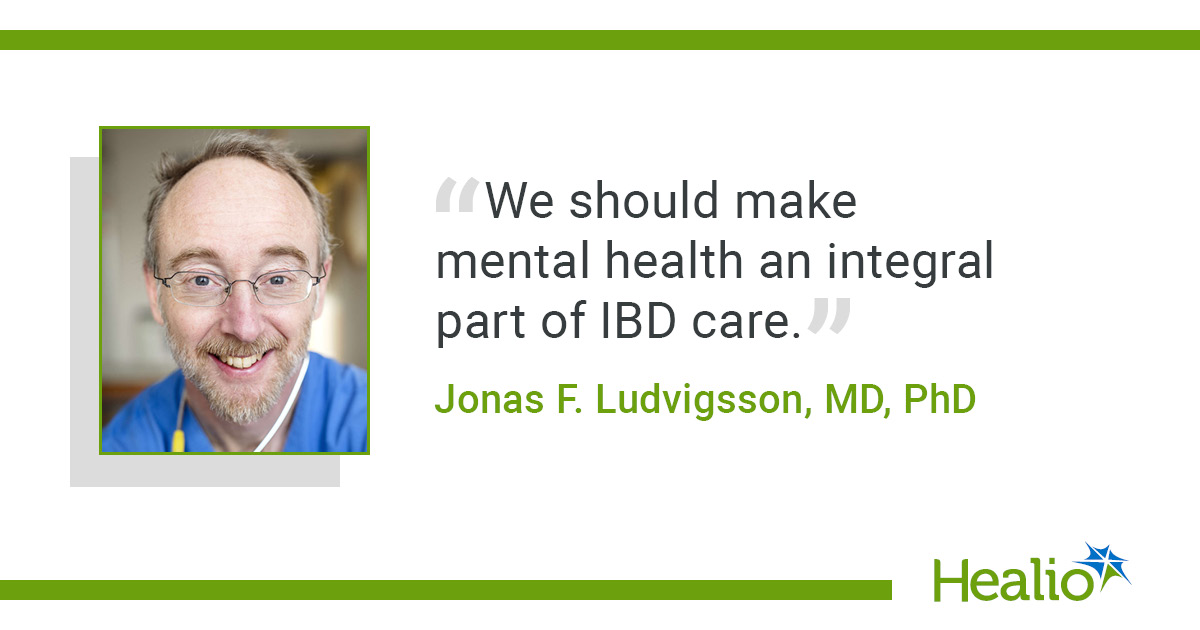
Ludvigsson: Most importantly, we should make mental health an integral part of IBD care. This is not an optional add-on. Questions about depression, anxiety and potential drug abuse should be part of the core conversation. This is especially so around the IBD diagnosis when risks are high.
From personal experience, I also note that some patients find it easier to open up to nonphysicians, so access to psychologists, IBD nurses and also primary care may help.
Healio: What is the most important takeaway from your study?
Ludvigsson: I think the key message is that mental health problems can occur both before and after IBD, and that they can remain for at least 10 years after IBD diagnosis.
Healio: How can future studies further investigate the correlation between IBD and psychiatric disorders?
Ludvigsson: I’d love to see more research around the mechanisms. I am an epidemiologist, so I probably need others to chip in here, but studies on the microbiome and gut-brain axis would be welcome. We also need large studies that can look into special risk groups where intervention might be an option.
Healio: Is there anything else you would like to emphasize?
Ludvigsson: In pediatrics, we work a lot with prevention, including vaccinations. I think that paradigm can be extended also to IBD care.
For patients with IBD but not yet mental health problems, how can we prevent such problems? Is the key only controlling the inflammation and making the patient feel that they have our support, or are there other things we could to do prevent future mental health disorders?
For more information:
Jonas F. Ludvigsson, MD, PhD, also is a pediatrician at Örebro University Hospital and adjunct professor of medicine at Columbia University in New York City. He can be reached at jonasludvigsson@ki.se.

Ask a clinical question and tap into Healio AI’s knowledge base.
- PubMed, enrolling/recruiting trials, guidelines
- Clinical Guidance, Healio CME, FDA news
- Healio’s exclusive daily news coverage of clinical data