
Finding Your Perfect Walking Pad Looking to integrate more movement into your workday or add a convenient fitness solution to your home? Walking pads have revolutionized how we approach daily activity, allowing us to walk while working, watching TV, or simply getting some exercise in a compact space. Homefitnesscode offers two popular models—the C1 and Q2 Pro—each with unique strengths designed for different user needs. This comprehensive comparison will help you decide which model best fits your lifestyle, space constraints, and fitness goals. Why choose a Homefitnesscode walking pad? These high-quality walking pads combine durability, user-friendly features, and space-saving design—making them an excellent choice for modern homes and workspaces. Their products consistently receive positive reviews for reliability and value. Source link

14th World Congress for Hair Research
Since beginning this blog in 2013, I have covered most of the World Congress for Hair Research biennial meetings. The 14th edition of the World Congress for Hair Research takes place from May 28-31, 2026 in Seoul, South Korea. It is being organized by the Korean Hair Research Society. 14th World Congress for Hair Research. May 28-31, 2026. 14th World Congress for Hair Research I am delighted that the 14th World Congress for Hair Research will take place in South Korea. The country now leads the world when it comes to having the most number of groundbreaking companies involved in curing hair loss. Make sure to check out my subsection on the numerous leading cutting edge South Korean companies involved in hair loss research. As always, the final Full Program Guide is very interesting. Numerous globally renowned hair loss researchers are presenting or participating. Among the ones I have covered thoroughly in the past and who are working on some truly groundbreaking work that could cure hair loss include: Dr. Angela Christiano, Dr. George Cotsarelis, Dr. Claire Higgins, Dr. Colin Jahoda, Dr. Sung-Jan Lin, Dr. Lu Le, Dr. Sarah Millar, Dr. Emi Nishimura, Dr. Ralf Paus and Dr. Michael Rendl. Of special note, one of the three joint Congress Presidents is Ohsang Kwon (also called Kwon Oh-sang), the world’s leading researcher of person-to-person (allogeneic) hair transplants. Also of interest, Dr. Hyuma Tsuji of Shiseido (Japan) is presenting on dermal sheath cup cells. Dr. Maria Hordinsky will present on the Phase 3 trial of Ireland-based Cosmo Pharmaceuticals’ androgen receptor (AR) antagonist Clascoterone topical solution 5% to treat androgenetic alopecia. A presentation on the other AR targeting drug (China-based Kintor Pharma’s KX-826) that is currently in Phase 3 trials will be made by Dr. Cheng Zhou of China. Several of the presenters have their own hair and skin related research labs that I have not covered in the past. These include Dr. Se Kyu Choi’s Choi Laboratory in South Korea; and Dr. Maria Kasper’s Kasper Lab in Sweden. As always, there are a huge number of presentations in relation to alopecia areata (AA) and JAK inhibitors. The combination of alopecia areata, alopecia totalis and alopecia univeralis accounts for less than 5% of all hair loss patients. Social Media Links for #WCHR2026 Source link
Text messaging approach improves FIT return rates for CRC screening
Add topic to email alerts Receive an email when new articles are posted on Please provide your email address to receive an email when new articles are posted on . ” data-action=subscribe> Subscribe We were unable to process your request. Please try again later. If you continue to have this issue please contact customerservice@slackinc.com. Back to Healio Key takeaways: Patients in an automated text messaging cohort returned FIT kits for CRC screening more often than those in a phone call cohort. Researchers noted no differences by age, sex, race or ethnicity. A text message reminder-based strategy significantly improved colorectal cancer screening rates among adults in underserved communities, compared with nurse-led telephone call outreach, according to study results. Findings from a quality-improvement randomized trial showed that automated messaging may be a more effective and lower cost strategy to increase fecal immunochemical test (FIT) completion. “This is really a universal phenomenon we are seeing with this switch from phone calls to text communication,” Leora I. Horwitz, MD, MHS, director of the division of healthcare delivery science and professor of population health at NYU Grossman School of Medicine, told Healio. “The world is changing and some people avoid picking up the phone from unrecognized numbers, or even recognized numbers sometimes. It turns out telephone calls are not as effective as we would like.” The study, conducted at eight federally qualified health centers in Brooklyn, New York, assessed FIT completion rates within 21 days of a patient’s test order. Participants were divided into two cohorts: one assigned to receive three automated text message reminders (n = 649; 64.4% women; mean age, 56.4 years) and the other assigned to receive a single nurse-led telephone call reminder (n = 626; 63.6% women; mean age, 56.7 years). Patients in the text cohort received FIT completion reminders on days 2, 5 and 8, whereas those in the telephone group received a single phone call reminder on day 8. Participants had designated English, Spanish or Chinese as their preferred language and had not opted out of receiving texts. Data showed significantly higher FIT completion in the text cohort (58.9% vs. 49.8%), with an absolute difference of 9 percentage points (95% CI, 3.6-14.5). The researchers observed no differences between groups by age, sex, race/ethnicity, or patient portal use. Healio spoke with Horwitz about the use of automated text messaging to improve patient outreach, the evolution of health care system communication and other projects. Healio: Colorectal cancer rates are rising at an alarming rate. How important is it to identify strategies like this that could increase screening for patients in underserved populations? Horwitz: Colorectal cancer in general is one of the least well-screened for cancers, and yet, the most treatable and preventable. Most screening is meh, frankly. I encourage it, but it is not great. But colorectal cancer screening is actually one of the few that really works, because you can remove polyps entirely when you find them. Colonoscopies are cancer-reducing and life-improving, but the procedure is not done nearly often enough, particularly for people in underserved populations. CRC screening with colonoscopy is expensive and intrusive. Patients have to take the day off, somebody has to go with them, they have to manage the prep. It can be a hassle. That’s why FIT is a commonly used alternative — particularly in under-resourced areas — because you can avoid colonoscopy in patients whose results come back negative. Healio: Nearly 60% of patients in the text group completed FIT screening within 21 days, outperforming the phone call group by 9 percentage points. Did that result surprise you and should it prompt health systems to rethink how much staff time is dedicated to traditional outreach? Horwitz: We were pretty surprised for all kinds of reasons. For starters, we generally assume that a personalized conversation between two human beings is desirable and effective. That is the gold standard that we measure against. Conversely, texting can feel less personal or less helpful. It is entirely possible that the phone call was great for the people who answered the phone. What we saw in this study is very typical in that we could only reach about half the people. Some of that is because people are just busy and some people don’t like to answer the phone. On the other hand, 95% of people got the text message. We designed the text message with a lot of behavioral science; we had a deadline and there was some social pressure of saying, ‘Your doctor is waiting.’ We had multiple reminders in the text cohort, which was great because we barely had the capacity to call everyone once, let alone two or three times. But we could send out three text messages easily. I grew up without a cell phone, but my kids grew up only with cell phones and texting. They find it almost intrusive and weird to have someone call them on the phone. It’s just culturally strange for them. Of course, they’re not the population we’re trying to reach with this. We’re trying to reach people like me who didn’t grow up with cell phones, but that will change over time. Healio: What does this say about how patients want to engage with health systems in 2026? Horwitz: I think it’s a good signal for us and we should learn from that. This was a project done with a pretty big group and some of our clinical staff were quite worried that our non-English speaking, older or immigrant populations might not respond well. So, we predefined subgroups to look at and found no differences at all. We want to make sure that things are equally effective in different groups, and, when they’re not, we have to change our behavior accordingly. We did our best to make sure of that. We sent messages in Mandarin to our Chinese-speaking patients and we sent messages in Spanish to our Spanish-speaking patients, which is another reason phone calls are hard — you need someone who can speak all those

La conexión de la inflamación tipo 2
English Del 18 al 22 de mayo de 2026 es la Semana de Concientización de la Inflamación Tipo 2. Cuando tu cuerpo enfrenta enfermedades, lesiones o la presencia de elementos extraños, tales como virus, bacterias o parásitos, la inflamación es el método que el cuerpo usa para defenderse y para iniciar el proceso de sanación. El sistema inmunitario reacciona a enfermedades y lesiones enviando células inflamatorias para detener esas amenazas. El resultado se denomina inflamación aguda, que podrías experimentar como: Dolor o sensibilidad Fiebre Hinchazón Piel enrojecida en el lugar de la lesión Si bien la sensación es desagradable, este tipo de inflamación es una reacción saludable. Desaparece una vez que el cuerpo sana. Pero con inflamaciones crónicas, tu cuerpo sigue enviando células inflamatorias durante meses o incluso años sin la presencia de una amenaza. En esos casos, el proceso que debería sanar tu cuerpo lo daña. Los proveedores de atención médica (HCP, por sus siglas en inglés) denominan a esto inflamación tipo 2. “Describo la inflamación tipo 2 como una categoría específica de hinchazón en el cuerpo, que se asocia comúnmente con trastornos alérgicos, los cuales pueden ocurrir en varios órganos a la vez, tales como en la piel, la nariz, las vías respiratorias y los pulmones”, dijo Payel Gupta, M.D., alergóloga con triple certificación y profesora clínica adjunta de SUNY Downstate Medical Center y Mt. Sinai Medical Center en Nueva York. “Si tienes este tipo de inflamación en una parte de tu cuerpo, también podrías tenerla en otra”. Trastornos relacionados Con tu piel, nariz, vías respiratorias y pulmones como lugares donde puede haber inflamación tipo 2, la lista de trastornos relacionados con este tipo de inflamación, incluyendo los que ocurren simultáneamente, es sustancial. Algunos trastornos coexistentes comunes son: Alergias: Una alergia es una reacción del sistema inmunitario a una sustancia que normalmente es inofensiva, tal como ciertos alimentos o plantas. Las personas que no tienen esa alergia generalmente no tienen ninguna reacción a esa sustancia. Asma: El asma es un trastorno pulmonar que causa inflamación y estrechamiento de las vías respiratorias de los pulmones, lo cual produce dificultades respiratorias que pueden ser leves o graves. Rinosinusitis crónica con pólipos nasales (RSCcPN): Con este trastorno inflamatorio crónico, se forman neoplasias benignas denominadas pólipos nasales en tus senos paranasales o nariz y pueden causar síntomas problemáticos, tales como presión sinusal y dificultad para respirar. Incluso después de cirugías para eliminarlos, los pólipos nasales frecuentemente reaparecen. Enfermedad pulmonar obstructiva crónica (EPOC): Con este trastorno, las vías respiratorias y otras partes de tus pulmones se deterioran por lo que respirar se vuelve difícil. Fumar es la causa más frecuente de la EPOC pero también hay otras causas, tales como contaminación ambiental. Eccema: El eccema es un trastorno inflamatorio crónico que causa que la piel se inflame, se seque y pique. La dermatitis atópica es la forma más frecuente de eccema. Esofagitis eosinofílica (EEo): Este trastorno crónico ocurre como reacción a desencadenantes tales como ciertos alimentos o alergenos ambientales. El esófago de una persona se inunda de glóbulos blancos, lo cual causa una inflamación dolorosa del esófago. Puede volverse difícil comer o tragar confortablemente. Prurigo nodular: Este trastorno, el cual causa protuberancias elevadas en la piel con comezón, puede aparecer en cualquier parte de tu cuerpo, pero es más frecuente en el abdomen, brazos y piernas. Urticaria: Urticaria es el término médico para ronchas, las cuales son habones rojos que pican y aparecen en cualquier parte de tu cuerpo y que frecuentemente desaparecen por sí solos. Durante períodos de semanas o incluso meses, ronchas pueden aparecer y desaparecer una y otra vez, frecuentemente sin una razón obvia. Esto se denomina urticaria crónica espontánea. Según Gupta, cuando personas tienen dos o más de estos trastornos, los proveedores de atención médica deberían considerar si una inflamación tipo 2 subyacente podría estar empeorando estos trastornos. “Desencadenantes ambientales que incluyen alérgenos como el polen, caspa de mascotas, ácaros del polvo o moho, así como contaminación o infecciones, pueden desencadenar o empeorar las inflamaciones tipo 2”, dijo. “En estos casos, es importante aliviar la inflamación tipo 2 subyacente lo más posible para reducir la gravedad de los trastornos coexistentes”. Una falta de concientización de la inflamación tipo 2 tanto de pacientes como de proveedores de atención médica puede contribuir con un diagnóstico tardío, especialmente si tienes más de un trastorno. Esta falta de concientización también implica que los trastornos pueden ser una carga importante en tu calidad de vida y podrías no saber que recibir una atención especializada posiblemente haga que tus trastornos inflamatorios crónicos sean mucho más manejables. Diagnóstico de la inflamación tipo 2 Tratar una inflamación subyacente requiere que un proveedor de atención médica identifique una inflamación que abarca más que solo un trastorno, tal como el asma o la EEo. Un método con el cual proveedores de atención médica pueden identificar si tienes una inflamación generalizada es medir la cantidad de eosinófilos en tu sangre. Los eosinófilos son un tipo de glóbulo blanco que protege el cuerpo de alérgenos. También pueden ser un marcador de inflamaciones tipo 2. Si tu sangre contiene demasiados eosinófilos, eso será útil para que tu proveedor de atención médica diagnostique una inflamación tipo 2. Otro método con el cual tu proveedor de atención médica podría identificar una inflamación tipo 2 en tu cuerpo es usando una prueba respiratoria denominada prueba de fracción de óxido nítrico exhalado. Esta prueba mide el monto de óxido nítrico que exhalas en cada respiración. Entre más óxido nítrico haya, más inflamadas estarán tus vías respiratorias, dijo Gupta. ¿Qué tipo de proveedor de atención médica puede diagnosticar o controlar trastornos relacionados con la inflamación tipo 2? Según Gupta, no siempre es necesario tener una consulta con un especialista inmediatamente si tus trastornos se controlan bien. “Pero si sientes que tus trastornos no se están controlando o no reaccionan bien a tus tratamientos actuales, deberías pedir que te refieran a un especialista”. Es posible que ya estés teniendo consultas con un especialista, desde luego. Por ejemplo,

Best Supplements for Bloating for Women According to Experts 2026
If you purchase an independently reviewed product or service through a link on our website, SheKnows may receive an affiliate commission. Bloating is a common issue for women of all ages. Whether you’ve indulged in foods that don’t agree with you, are dealing with hormonal changes, or have had too much fiber, it’s an uncomfortable (and sometimes painful) experience. And if you regularly deal with bloating, adding a supplement to your diet can be an easy way to find relief. The best supplements for bloating for women are specially designed to ease water retention and regulate your body’s systems. Best Supplements for Bloating for Women at a Glance Best Overall: AG1 Next Gen Pouch, $79 monthly (originally $99)Most Affordable: Bio.me Psyllium Husk Fiber, $14 (originally $20)Best Ashwagandha supplement for Bloating: Moon Juice Ashwagandha, $28 (originally $38)Best Prebiotic Supplement for Bloating: Promix Debloat: Prebiotic + Probiotic, $58Best Magnesium Supplement for Bloating: Thorne Magnesium Glycinate, $26Best Fast-Acting Supplement for Bloating: Arrae Bloat, $55Best Enzyme Supplement: Pure Synergy Enzyme Power, $50 Related story Parke’s Coastal Collection Officially Launches Today — What to Know About Their Biggest Sweatshirt Drop of the Summer “For bloating, I recommend trying these three categories of supplements: digestive bitters and herbs like fennel, ginger, and cumin; adaptogenic herbs like ashwagandha and holy basil that calm stress-related gut issues; and magnesium supplements to reduce water retention,” explains Shruti Mishra, a certified nutritionist and the founder of Osh Wellness. To help you understand how supplements can help with bloating, we spoke with experts who shared what to look for when shopping for supplements, which ingredients to consider, and the best options. bEST OVERALL AG1 Next Gen Pouch $79 (monthly) $99 20% off The AG1 Next Gen Pouch gets the title of our best overall supplement for bloating, as it takes a comprehensive approach to “fostering a healthy, balanced gut microbiome and supporting efficient digestion,” AG1 says. The powder is crafted with high-quality nutrients such as vitamins, minerals, antioxidants, and mushrooms, for a total of over 75 vitamins, minerals, and whole-food-sourced ingredients. In addition to reducing bloating, AG1 also helps to bolster digestion and nutrient absorption, so you feel energized and have fewer cravings. Ingredients: vitamins and minerals, pre- and probiotics, stress adaptogens, antioxidants (vitamin E and B-complex), superfoods (like ginger and pea protein) and mushroomsSize: 13.8 oz.Type: Powder Most Affordable Bio.me Psyllium Husk Fiber “Psyllium husk is cheap and well tested,” says Anna Mapson, registered nutritional therapist, author, and host of the podcast Inside Knowledge For People with IBS. “Start with a small amount, such as one capsule, and increase slowly. In research, people are given doses of around 10g to 15g, so you can take quite a lot, but start with lower doses to begin.” Ingredients: Organic psyllium husk fiber, magnesium, chloride, sodium, and potassiumSize: 180 capsulesType: Capsules Best Ashwagandha Supplement Moon Juice Ashwagandha Mishra says, “I would point readers to ashwagandha (KSM-66 or Sensoril, 300–600 mg/day) to lower cortisol-driven bloating.” If you’re not sure what to consider, add Moon Juice’s Ashwagandha mix to your list. The adaptogenic herb helps to reduce stress and regulate cortisol levels when taken consistently. It’s a breeze to add to either your morning or evening routine. Just add the recommended serving size to your coffee, smoothies, or favorite drink before bed. Ingredients: Organic Ashwagandha root extractSize: 1.3 oz.Type: Powder Best Prebiotic Supplement Promix Debloat: Prebiotic + Probiotic The Promix Debloat: Prebiotic + Probiotic is also recommended by experts, since it reduces bloating and cramping without causing additional discomfort. The supplement is crafted to improve digestive comfort, combat bloating, and support overall gut health, the brand says. Its results are evident in its formula, which features wild-harvested organic baobab and 5 billion CFU (3 probiotic strains) to support a healthy gut. Ingredients: Probiotics, baobab, turmeric, monkfruit, vitamin CSize: 0.07 oz. per stick (30 count)Type: Powder Best Magnesium Supplement Thorne Magnesium Glycinate Mishra also suggests magnesium glycinate (200–400 mg at night) to support gastrointestinal (GI) motility and sleep. Thorne’s Magnesium Glycinate is one of the best you can snag. It comes in capsule form, making it simple to add to your daily diet. Each capsule contains highly absorbable magnesium bound to glycine, which promotes restful sleep and supports healthy digestive and organ function. Ingredients: Magnesium glycinate and silicon dioxideSize: 90 capsulesType: Capsule Best Fast-Acting Supplement Arrae Bloat When bloating calls, make sure to have the Arrae Bloat on hand. This supplement is designed to soothe digestive discomfort within 1 hour and support the body’s digestion of hard-to-digest foods. Its formula offers fast relief and is packed with a blend of five organic herbs (lemon balm, peppermint, dandelion, ginger, and slippery elm), alongside bromelain (a pineapple-derived digestive enzyme). Ingredients: Peppermint, dandelion, ginger, and slippery elm, dandelion, ginger, and othersSize: 60 capsulesType: Capsules Best Enzyme Supplement Pure Synergy Enzyme Power Dr. Chanté Wiegand, a licensed naturopathic physician and VP of Science & Education at The Synergy Company, says that the Pure Synergy Enzyme Power delivers a full spectrum of meticulously measured digestive enzymes to break down protein, fat, dairy, and plant fiber. “It is optimized with a digestive herbal blend including ginger, fennel seed, and turmeric, specifically designed to soothe temporary gas and bloating while fostering bowel regularity,” she adds. Ingredients: Bromelain, papain, protease, peptidase, acid protease, and lactaseSize: 90 capsulesType: Capsules Frequently Asked Questions What Causes Bloating? Mapson explains that there is rarely a single cause of bloating, but it can be triggered by constipation, food intolerance, stress, and bacterial overgrowth. “Another big factor I see with my clients is undereating. If you skip meals, eat a very small volume of food, then your digestive system can slow down, which can lead to bacterial overgrowth in the small intestine,” Mapson adds. Dr. Kristy Appelhans, global HCP scientific education manager at Metagenics, also says that other bloating culprits include general day-to-day inflammation; hormonal fluctuations associated with menstrual cycles or otherwise (men/women), pregnancy, or peri/menopause; dehydration; and stress. How to Choose the Right Supplement for Bloating? Dr. Appelhans
Raw milk linked to dozens of illnesses in Idaho, officials say
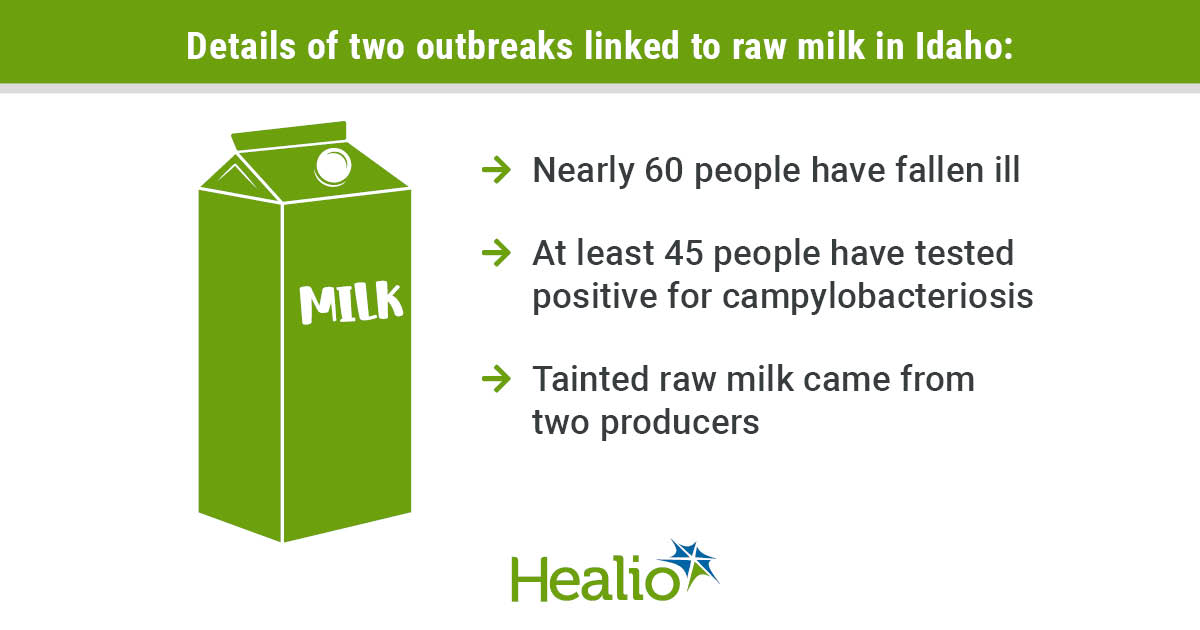
Add topic to email alerts Receive an email when new articles are posted on Please provide your email address to receive an email when new articles are posted on . “ data-action=”subscribe”> Subscribe We were unable to process your request. Please try again later. If you continue to have this issue please contact customerservice@slackinc.com. Back to Healio Key takeaways: Out of nearly 60 people who have fallen ill after consuming raw milk, at least 45 have tested positive for campylobacteriosis. Most people who were sick reported drinking raw milk from two different producers. Health officials are investigating two separate foodborne outbreaks that have sickened dozens of people in Idaho who drank raw milk. Since May 19, nearly 60 people have fallen ill after consuming raw milk, according to the Idaho Department of Health and Welfare (DHW). At least 45 of those people have tested positive for campylobacteriosis, a bacterial infection that can cause diarrhea that is sometimes bloody, fever, stomach cramps, nausea and vomiting, the department said. Data derived from the Idaho Department of Health and Welfare. Most people who were sick reported drinking raw milk from two different producers — one in northern Idaho and one in southern Idaho, according to the state health department, which did not name the producers. “Both milking operations are working in collaboration with DHW and local public health agencies to identify and fix any potential sources of contamination,” the department said in a press release, which noted that authorities are currently testing samples to help detect batches that might be tainted. The CDC cautions against consuming raw milk as it exposes consumers to harmful pathogens such as Escherichia coli, Listeria and Salmonella. Raw dairy does not undergo a pasteurization process, which is the only way to effectively kill harmful bacteria, according to the CDC. Younger children, older adults, pregnant women and people with weakened immune systems are at greater risk for severe illness from raw dairy, the CDC said. In April, a California dairy recalled some raw cheese products that the FDA said may be responsible for a multistate E. coli outbreak. An infant in New Mexico died earlier this year from a Listeria infection officials believe was contracted through exposure to unpasteurized milk consumed by the infant’s mother during pregnancy. Published by: Ask a clinical question and tap into Healio AI’s knowledge base. PubMed, enrolling/recruiting trials, guidelines Clinical Guidance, Healio CME, FDA news Healio’s exclusive daily news coverage of clinical data Learn more Add topic to email alerts Receive an email when new articles are posted on Please provide your email address to receive an email when new articles are posted on . “ data-action=”subscribe”> Subscribe We were unable to process your request. Please try again later. If you continue to have this issue please contact customerservice@slackinc.com. Back to Healio Source link

Sopranos Star Jamie-Lynn Sigler Talks Multiple Sclerosis
You probably recognize actress Jamie Lynn Sigler from her role as Meadow on the award-winning drama, The Sopranos. On screen, life for the Sopranos family was complicated and often shrouded in secrecy. Off camera, Sigler was dealing with a secret of her own: She was living with relapsing multiple sclerosis (RMS) — a chronic disease that can affect the brain, spinal cord and optic nerves and causes unpredictable flare-ups. Siegler was just 20 years old when she was diagnosed and still filming the popular TV show. For 16 years, she kept her diagnosis to herself, in part because she was afraid that people wouldn’t want to work with her. Now, in her new book, And So It Is … A Memoir of Acceptance and Hope, Sigler takes readers behind the scenes of her time filming The Sopranos, her MS diagnosis and the life experiences that led her to become an advocate for the MS community. We talked to Sigler about managing MS, her memoir and the surprising perks of midlife. This interview has been lightly edited for clarity and length. HealthyWomen: For people who haven’t read your memoir, can you describe how relapsing multiple sclerosis (RMS) has affected your life? Jamie Lynn Sigler: I was 20 when I was diagnosed, and my reaction to the diagnosis, as one can imagine at that tender age, was fear. I was overwhelmed. I didn’t really have any example or anyone to look to that I knew who was living with the disease, and I reacted by living in denial, shutting down, keeping it a secret and not asking questions. I assumed that the less I knew the safer I would feel. Pre-MS I was already somebody that was riddled with insecurities and fears and labels that I put upon myself of not being good enough and not being worthy, and the disease really amplified those feelings. Over the years, I carried this heavy weight of guilt and shame for keeping the secret, for having the disease, and allowing myself to go through this alone in my own head and creating a very difficult existence. Thankfully, I eventually found myself at a time where I had broadened the circle beyond my immediate family just enough for my friends and my loved ones to remind me that MS didn’t define me — it didn’t take away my worth — and that I deserve to live a life of truth and authenticity. Then I had a child, and I was ready to face my biggest fear, which was going public with MS, and the undoing of living in secret and finally facing what it’s like to live in your truth and to share authentically and vulnerably and then that allows for healing, not just of the physical body but of the self. I think what MS ended up becoming for me was this invitation to look within — to stop me in my tracks in a way that felt devastating but also now I see was a gift of being able to really heal parts of me and of myself that maybe otherwise I wouldn’t have given myself the time to do. in her dressing room HW: Why was it important for you to write this memoir now? Sigler: I’ve been through so many stages of not just this disease, but of life in general, and I’ve learned through my advocacy and through being a public figure that we all experience pain, we all experience struggle, and emotions are a universal thing that we all feel — and how isolated we can feel within them. So, the more that you open up and the more that you share in your vulnerability, the less alone you feel and the less alone you allow others to feel as well. I assumed in talking about my RMS journey that it would only resonate within the MS community, but on the daily I have people say, “I don’t have MS but I feel you and I understand what you’re saying and I saw myself in your story in so many ways even though our lives are vastly different.” I’ve had grown men tell me that as well, which has been so lovely. I find that I feel so much more confident not only in my skin but in my voice — I found my voice in just being imperfect and being flawed and saying sometimes that I’m not OK, or that I’m scared or I’m sorry — being able to accept all the parts of myself has allowed me to be a more confident person moving forward, and it allowed me to have more grace and forgiveness for life in general, but most importantly for myself. HW: What’s one thing you’ve learned about relapsing MS that you wish you could tell your younger self when you were newly diagnosed? Sigler: Through my recent collaboration with Novartis I’ve really been able to focus on telling my story and having a voice in my treatment and in my journey. For so long, I assumed that just too much information would be overwhelming. I didn’t want to know. But what I’ve learned over time is asking the questions with my MS specialist, being involved in what type of treatment I felt was right for me taking into consideration my life, my dreams, my circumstances — and not just feeling like I’m across the table being told what to do, and getting some control, getting some independence back into my life when it came to my relapsing MS really changed the game for me. One of the resources that we created together was a treatment decision guide because it’s incredibly overwhelming, especially if you’re newly diagnosed.You don’t know the questions to ask. You have all of these what-ifs and scenarios racing through your head, so to give somebody detailed questions to ask their healthcare provider so they can make an informed decision together with their MS specialist, taking into consideration all that their

The Arrector Pili Muscle (aka Goosebump Muscle)
I originally wrote this post on the arrector pili muscle (APM) and its connection to androgenetic alopecia (male pattern hair loss) in 2017. This was followed by important updates in 2020 and 2022. And now we have yet another major update again in 2026. Note that this post is in chronological order, so the latest update is at the bottom. Jan 10, 2017 Androgenetic Alopecia: New insights into the role of the Arrector Pili Muscle Several weeks ago, the arrector pili muscle got significant coverage in a few newspapers around the world. Famed Australian dermatologist Dr. Rodney Sinclair co-authored an important paper titled “The arrector pili muscle, the bridge between the follicular stem cell niche and the interfollicular epidermis” that was just published this month. Dr. Sinclair has been involved in this area of hair loss research for a few years. See his 2014 paper titled: Beyond goosebumps: Does the arrector pili muscle have a role in hair loss? Also see the very interesting new insights on the APM section of his website. Australian newspapers were especially interested in this latest study and its findings as evidenced by articles such as this one and this one. The Arrector Pili Muscle Arrector pili muscles are small muscles attached to individual human hair follicles on both the scalp as well as body (so we have millions of these muscles throughout our bodies). Contraction of these muscles causes hairs to stand up, a phenomenon that is known as goosebumps. Therefore, the musculus arrector pili is often referred to as the goosebump muscle. Every hair root is connected to the arrector pili. This smooth muscle contracts in response to signals from the “fight or flight” sympathetic nervous system. Arrector Pili Muscle Degeneration and Hair Loss In recent years, a few studies have come out that suggest a possible connection between the arrector pili muscle degenerating (where it gets replaced by fat) and hair loss due to the subsequent disconnection between various hair follicle stem cell populations. It is possible that an intact APM plays a crucial role in the maintenance of follicular integrity and stability. However, there are many uncertainties about this theory that I discuss in the next section. It seems that while in alopecia areata (AA) patients the arrector pili muscle remains intact, this is not true in androgenetic alopecia (AGA) patients. So this could be why it is much easier to grow back hair for people with AA compared to people with AGA. Unfortunately, over 95 percent of balding men suffer from AGA. Of note, the rate at which the arrector pili muscle degenerates and gets replaced by fat varies substantially between patients and between individual hairs on the same scalp. Some miniaturized vellus hairs in balding regions might even never lose most of their arrector pili muscle connection. My Thoughts and Points of Contention According to Dr. Sinclair’s own quote from a past paper, “It remains unclear whether arrector pili muscle regression is a cause or effect of permanent follicle miniaturization“. I think this is the crux of the issue surrounding this theory/hypothesis. I am curious why hair that is transplanted from the back of a person’s scalp to the front grows so well if the arrector pili muscles in front have been destroyed? Surely the transplanted hair cannot just automatically regenerate the APM? Related to the above, an important Japanese study from 2012 concludes that correctly transplanted hair can re-enable “connectivity and cooperation” with the arrector pili muscle and nerve system. In effect, it might be very possible to reactivate or regenerate the APM. In Dr. Tsuji and his team’s groundbreaking technology “the transplanted primordium also forms connections with surrounding tissues (arrector pili muscle and nerves) and repeats normal hair cycles”. There are 100s of online anecdotal reports with before and after photos of people re-growing long-lost hair in bald scalps. Miracle results are especially common in people undergoing male-to-female transition regimens. You can also find many reports of surprising hair regrowth in many old men who recently started taking dutasteride for enlarged prostate issues. And the Reddit result logs from people taking oral minoxidil are sometimes spectacular. Maybe they regenerated their arrector pili muscles; or maybe those muscles always remained intact in spite of severe AGA; or maybe one can regenerate hair without the need for having any intact arrector pili muscles? It is unclear when exactly we have a point of no return where the arrector pili muscle is largely or entirely replaced by fat and hair stops growing (either as a cause or effect). It seems like there is significant variation depending on the person and hair follicle. In many cases, the APM might not be entirely degenerated and replaced by adipose tissue even in areas of the scalp where one has been bald for several decades. In such cases, subsequent hair and muscle regeneration could then be possible via something like dutasteride or finasteride. Update: August 7, 2020 Goosebumps, the Sympathetic Nervous System and Hair Growth Yesterday, Taiwanese and US researchers published an important paper titled: “Cell Types Promoting Goosebumps Form a Niche to Regulate Hair Follicle Stem Cells.” The work was led by Dr. Sung-Jan Lin of National Taiwan University, in collaboration with researchers from Harvard University (US). Goosebumps, Arrector Pili Muscle and Hair Growth. The scientists made some important discoveries in relation to the arrector pili muscle and the sympathetic nervous system. The APM maintains sympathetic innervation to hair follicle stem cells. (HFSCs) The sympathetic nerve activates HFSCs via synapse-like contacts and norepinephrine. An important quote: “APMs are often lost in the scalp skin of people with androgenetic alopecia. It is possible that in such skin, loss of APMs leads to the loss of sympathetic nerves, making HFSCs more difficult to activate. Our results also suggest the potential of using selective β2 agonists to promote HFSC activation.” Lin’s team found that the biological mechanism behind baldness in men is closely connected to the sympathetic nervous system. Hair follicle stem cells activate after receiving signals via what

Q&A: Common pesticide linked to early-onset colorectal cancer
Add topic to email alerts Receive an email when new articles are posted on Please provide your email address to receive an email when new articles are posted on . “ data-action=”subscribe”> Subscribe We were unable to process your request. Please try again later. If you continue to have this issue please contact customerservice@slackinc.com. Back to Healio Key takeaways: Researchers found the pesticide picloram may be linked to rising early-onset colorectal cancer incidence around the world. Diet and smoking also were associated with incidence. A global, commonly used pesticide could be associated with the rising incidence of early-onset colorectal cancer. A pair of analyses identified picloram, which the EPA described as “a systemic herbicide used to control deeply rooted herbaceous weeds and woody plants in rights-of-way, forestry, rangelands, pastures and small grain crops,” as a potential new risk factor for the disease. Researchers identified the pesticide, picloram, as a potential new risk factor for colorectal cancer. Image: Adobe Stock. José A. Seoane “We didn’t have any clue,” José A. Seoane, PhD, head of the cancer computational biology group at Vall d’Hebron Institute of Oncology in Spain, told Healio. Researchers found smoking, diet and educational attainment to be associated with early-onset colorectal cancer, as well. However, Seone emphasized the data could not determine causality. David J. Lee, MD, MPH, MMSc, a hematology/oncology fellow at Dana-Farber Cancer Institute, and colleagues published an accompanying perspective paper in Nature Medicine highlighting this and other questions. “Many unknowns remain about whether and how picloram actually causes early-onset colorectal cancer,” Lee said in a press release. “We are many steps removed from confirming that this is a risk factor for colorectal cancer, but I think what is novel and interesting is the approach the authors took to assess for various environmental exposures in patients with colorectal cancer.” Healio spoke with Seoane about the data, future research and more. Healio: Why did you conduct this study? Seoane: The clinical collaborators of my institute were surprised about the amount of newly diagnosed early-onset colorectal cancer they were getting. Ten, 15 years ago, they had one patient from time to time. Now, they are diagnosing several every month. They are alarmed, and this is a general trend. It is not just here. They asked me, ‘Are they different molecularly? Why is this happening?’ Clinically, these tumors are more aggressive than the regular-onset ones. In my lab, we study genomics, proteomics and epigenomics of tumors. We started to check what are the characteristics of these early-onset tumors, and as other teams already did, they didn’t find anything specific. We have tumors that are molecularly similar, but we have more tumors that were not there 20 years ago. If the tumors are the same, we thought that it must be something external. Healio: How did you proceed? Seoane: We came up with this idea of interrogating the methylation of the tumor. The first author, Silvana C.E. Maas, PhD, a postdoctoral researcher at Vall d’Hebron, was studying how the epigenome changed by external factors, as smoking or alcohol consumption. We know many things that we do change our epigenetic landscape. If this is something that is outside, and we can read it within the tumor, then we can compare the exposure between early-onset and late-onset cancer and see if there is some external factor that is not the same between the two tumors. Healio: What did you find? Seoane: Signals of poor diet are more present in the early-onset tumors. We see the same with smoking, where we see that early-onset tumors have more smoking exposure. And then we have this pesticide, which was quite surprising for us because it was never mentioned anywhere that this pesticide could be associated with any type of tumor. Healio: What was your reaction to the pesticide finding? Seoane: We were super skeptical with this first result, and that’s why we went to the population analysis. We got some data about colorectal cancer incidence from SEER, and we identified this other database that measures the use of pesticides per county in U.S. We used a model to find the overlap between the two databases. Then picloram shows up. In the first model we did, picloram was the third hit. One of the journal reviewers was very skeptical, and they said the pesticides are not used alone. Sometimes you use pesticides or a herbicide together with other ones. You should check. We adjusted the model for every other single pesticide. Then, picloram was the highest hit. The first hit in our first analysis was glyphosate. Then it came to the second position after the proper adjustment. Healio: Did it have any association with late-onset colorectal cancer? Seoane: We didn’t check that specifically. We only analyzed the incidence of early-onset colorectal cancer. Healio: How concerning are these findings? Seoane: Keep in mind that this is an observational study. These are two observational studies that are leading us to the same risk factor. They are not causal. We cannot establish causality with the type of analysis we are doing. That is one of the main criticisms that we are seeing. This is the first limitation of the study. We can’t say picloram causes early-onset colorectal cancer. We are doing two analyses that are totally different in terms of the data sources and the type of analysis, and we are seeing the same factor. This is concerning. This is a pesticide that is [commonly] used [in certain parts of the world]. We should push to do much more analyses, much better studies associated with this pesticide. Healio: What was your reaction to the diet, smoking and education data you found? Was that surprising? Expected? Seoane: Epidemiologists have been trying to identify factors that are associated with early-onset colorectal cancer, and smoking and diet have already been detected. Diabetes, too. We identified educational attainment as a proxy. People with poor educational attainment often have poor diet, too. All the signals

Síntomas de la esofagitis eosinofílica (EEo)
¿Qué es la esofagitis eosinofílica (EEo)? La EEo es un trastorno inmunitario crónico y de por vida que afecta el esófago. Los eosinófilos son un tipo de glóbulo blanco que protege el cuerpo como una respuesta contra desencadenantes tales como alérgenos alimentarios y ambientales. La EEo ocurre cuando eosinófilos se acumulan en tu esófago debido a alérgenos causando inflamación. Los síntomas de la EEo incluyen: Estos síntomas podrían ser intermitentes, podrían aparecer cada cierto tiempo o podrían ser constantes. Bebés y niños pequeños con EEo podrían tener dificultades para alimentarse y podrían vomitar. Es posible que no reciban suficientes nutrientes necesarios para crecer apropiadamente. Esto se denomina retraso del crecimiento . Diagnóstico de la EEo La EEo la diagnostica un gastroenterólogo usando un procedimiento denominado endoscopía superior con una biopsia. Esto permite que tu proveedor de atención médica (HCP, por sus siglas en inglés) trate de detectar inflamación y eosinófilos (glóbulos blancos) en el esófago. Tratamiento y control de la Eeo No hay cura para la EEo, pero tratar y controlarla puede ser útil para mantenerla bajo control. Dieta Identifica y evita alimentos específicos que desencadenen inflamación con la guía de un proveedor de atención médica. Medicamentos Las medicinas incluyen: Las medicinas pueden ser útiles para: Disminuir el monto de ácido que tu estómago genera Reducir la hinchazón y la inflamación Mejorar la capacidad de tragar Eliminar la necesidad de cambios de dieta El tratamiento no es universal. Encuentra un método que sea útil para que te sientas mejor y que mantenga tu EEo bajo control a largo plazo. Tratar la EEo es importante La EEo es un trastorno crónico y de por vida que requiere monitoreo y control continuo, incluyendo endoscopías para monitorear el progreso del trastorno y la eficacia del tratamiento. Si no se trata: La inflamación podría causar cicatrices en el tejido El esófago podría estrecharse Comer podría ser doloroso Podrían atorarse alimentos en tu esófago El trastorno puede empeorar Si tienes síntomas de EEo, habla con un gastroenterólogo. Recursos CueAsociación americana para trastornos eosinofílicos stionario de la American Gastroenterological Association:¿Tengo EEo? Este recurso educativo se preparó con el apoyo de Regeneron, Sanofi y Takeda. Source link